


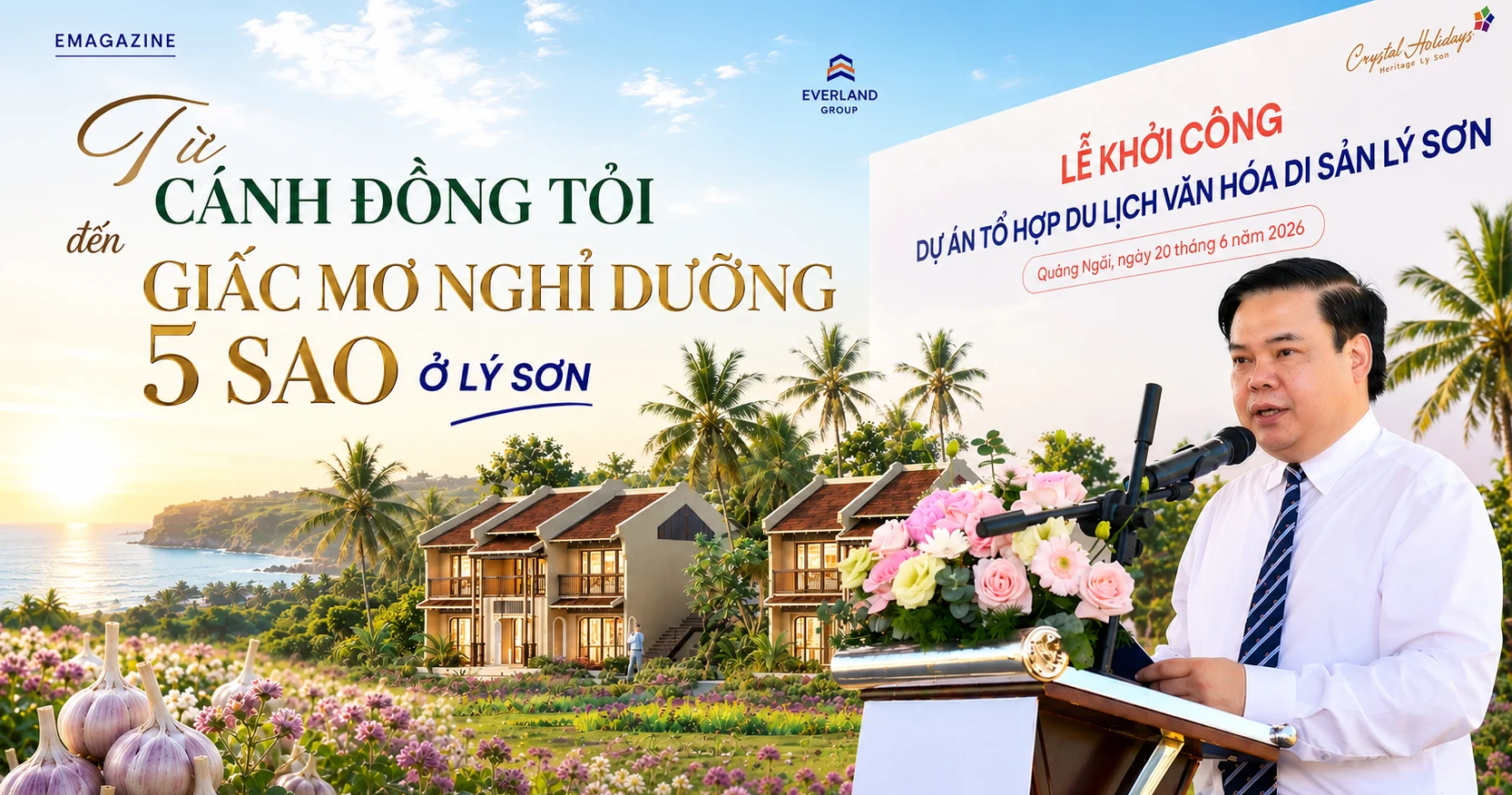
Everland Group has officially broken ground on the Crystal Holidays Heritage Ly Son cultural heritage tourism complex. The ceremony itself was modest and understated, yet its significance extends far beyond the event.
With a total investment of VND 600 billion, the project may appear relatively modest compared with today's multi-trillion-dong resort developments. Even within Everland's own investment portfolio, it is not the company's largest project.
Its true value, however, lies elsewhere.
A turning point for Vietnam's garlic island
Perhaps few groundbreaking ceremonies have carried greater symbolic significance for Ly Son Special Zone - Vietnam's remote island outpost where million-year-old volcanic formations stand alongside garlic fields weathered by sea winds, while the legacy of the legendary Hoang Sa Flotilla continues to shape the islanders' identity.
Covering just over 10 square kilometers, Ly Son is home to nearly 20,000 residents, most of whom make their living from fishing and garlic farming. Against this backdrop, the arrival of an integrated luxury resort represents far more than another real estate project. It signals a gradual yet meaningful transformation of the island's economic structure, where tourism is increasingly expected to become a sustainable pillar of growth, creating new livelihoods and long-term opportunities.
In reality, Ly Son has long possessed attractions capable of captivating visitors. The dramatic To Vo Gate glowing beneath sunset skies, the towering cliffs of Hang Cau, the windswept summit of Thoi Loi Mountain, and the untouched beauty of Be Island have steadily drawn growing numbers of travelers.
Yet one paradox has persisted. Despite increasing visitor arrivals, the island's tourism infrastructure has lagged behind, with very few high-quality accommodation options available. Today, Ly Son has only two relatively small hotels Muong Thanh and Dao Ngoc, while most visitors stay in aging guesthouses or family-operated homestays.
Against this backdrop, Crystal Holidays Heritage Ly Son is expected to help address the island's shortage of premium accommodation, enhancing visitor experiences while encouraging longer stays.
Infrastructure challenges and a test of patience
Behind the investment decision lies a challenge far greater than construction itself.
Located nearly 15 nautical miles offshore approximately 45 minutes by high-speed ferry Ly Son remains a destination that feels simultaneously close and distant. Infrastructure remains limited, the tourism workforce is still developing, and both construction and operating costs are significantly higher than on the mainland.
Consequently, VND 600 billion represents more than financial investment. It is a test of vision, patience, and long-term commitment.
"It's certainly a bold decision," remarked Dr. Le Dinh Vinh, Chairman of Everland Group, half-jokingly.
He openly acknowledged the challenges of investing in Ly Son: limited infrastructure, the absence of dedicated tourism ports and sufficient transport services, underdeveloped local tourism facilities, and the complexities of operating a luxury resort on an offshore island, all while accepting a considerably longer investment payback period.
"There are many challenges, but the opportunities are equally significant. We've made a long-term commitment to Ly Son."
According to Dr. Vinh, this commitment extends beyond business calculations. It also stems from his personal affection for the island, developed during previous visits as a traveler.
"I've visited Ly Son several times and was completely captivated by its beauty," he recalled.
The opportunity emerged in 2021, when Everland acquired the project from its previous developer after the tourism industry had been severely affected by the COVID-19 pandemic. Construction could have begun as early as 2023, but was postponed following adjustments to the island's master planning process.
Had patience been lacking, walking away would have been understandable.
Instead, Everland stayed.
Dr. Vinh believes Ly Son's tourism appeal is undeniable. Yet as long as tourism relies primarily on backpackers and small-scale homestay accommodation, achieving a true breakthrough and establishing a viable luxury tourism market would remain difficult.
Everland therefore chose a different path: developing an international-standard five-star resort aimed at premium travelers, particularly international visitors seeking authentic destinations that remain largely untouched.
This vision is shared by Mr. Nguyen Trung Khanh, Director General of the Vietnam National Authority of Tourism, who believes projects of this nature not only attract longer-stay visitors and create local employment, but also help position Ly Son as a national center for marine tourism while preserving its cultural and heritage values.
Similarly, Mr. Nguyen Van Huy, Chairman of the People's Committee of Ly Son Special Zone, noted that the local government is prioritizing investments capable of maximizing the island's cultural heritage and natural assets while encouraging environmentally responsible tourism models. Quang Ngai Province is also proposing special policy mechanisms to attract strategic investors.
Unlocking new destinations
Ly Son forms part of Everland's broader long-term strategy: unlocking destinations with exceptional potential that remain largely undiscovered.
Rather than competing in mature markets such as Nha Trang, Da Nang, or Phu Quoc, the company has deliberately focused on emerging destinations including Van Don, Phu Yen, and now Ly Son.
In Van Don, the first phase of Crystal Holidays Harbour Van Don, comprising more than 2,000 hotel rooms and resort apartments, is expected to welcome guests later this year. Meanwhile, several large-scale developments are also progressing in Dak Lak Province (formerly part of Phu Yen).
"Being first always involves risks," Dr. Vinh said. "But tourism thrives on novelty, and that's exactly what creates lasting appeal."
According to him, developers essentially face two choices: invest in established destinations that are relatively safe but increasingly homogeneous, or venture into new territories where challenges are greater but opportunities for differentiation are far more compelling.
"What seems ordinary today may become highly attractive a few years from now."
For destinations like Ly Son, success depends not only on infrastructure or tourism products, but also on the ability to tell compelling stories.
"Tourism needs stories that truly resonate. Ly Son has countless remarkable stories, they simply haven't been told effectively."
These stories range from the island's maritime heritage to its extraordinary geology: an island formed by more than ten ancient volcanic craters over tens of millions of years.
"International visitors are fascinated by these kinds of stories. We've already seen Japanese travelers discovering Ly Son independently and sharing their own experiences with others."
Yet storytelling extends beyond history and nature.
It also finds expression through architecture, materials, and the guest experience itself.
To bring this vision to life, Dr. Vinh appointed Architect Cung Thanh Dat, Director of Baumschlager Eberle Vietnam, whose portfolio includes numerous culturally inspired hotels and resorts throughout Vietnam.
Architect Cung Thanh Dat shares the design concept behind Crystal Holidays Heritage Ly Son. Video: Hoang Anh.
According to Architect Dat, projects with substantial investment costs such as Ly Son must target discerning international travelers with both purchasing power and refined aesthetic expectations in order to ensure long-term operational success.
Crystal Holidays Heritage Ly Son distinguishes itself through its design philosophy.
Inspired by An Hai Communal House, the resort adopts low-rise architecture that blends harmoniously into the surrounding landscape, with buildings discreetly nestled within lush tropical gardens.
"Our design journey began with the concept of 'Origins,' drawing inspiration from An Hai Communal House, the Sa Huynh civilization, and Cham cultural heritage," he explained.
The resort embraces a philosophy of tranquility, creating intimate and secluded retreat spaces. A sense of mystery is achieved through layered indigenous vegetation, functioning as a natural ecological buffer that preserves the island's pristine character. Locally sourced stone, timber, and natural materials dominate the architecture, maintaining the island's rustic charm and maritime identity. Every pathway, water feature, and architectural element has been carefully positioned to integrate seamlessly with the terrain while minimizing environmental impact.
This philosophy aligns closely with the vision promoted by tourism authorities: tourism development must go hand in hand with heritage conservation.
According to Mr. Nguyen Trung Khanh, the project not only addresses the shortage of five-star accommodation but also helps attract higher-spending visitors, extend average lengths of stay, create employment opportunities, stimulate supporting industries, and demonstrate a long-term commitment to protecting Ly Son's cultural heritage, natural resources, and ecological environment.
Nevertheless, Dr. Vinh believes that private investment alone cannot transform the island.
For Ly Son to truly flourish, it requires an integrated development ecosystem encompassing planning, transport infrastructure, tourism services, dedicated passenger vessels, efficient mobility systems, and the participation of many more investors.
"The most important thing is that everyone shares the same long-term vision," he concluded. "Only then can Ly Son become a truly compelling island destination for both regional and international travelers."/.


